Organic mattresses · Sleep safety · Materials
Naturepedic 2-in-1 Mattress: Comparing Firmness and Waterproofing Options
A mattress with two different surfaces can seem like a clever answer to a child’s changing needs. But “2-in-1” can describe different products for different ages, and that distinction matters. Here’s how to understand firmness, waterproofing and fit—and why a softer side should never be treated as an infant sleep surface.
Published November 22, 2026
A crib mattress looks simple from the outside: a flat rectangle covered in fabric, fitted neatly inside a frame. Its details, however, involve more than softness or the feel of a surface. The mattress must fit the crib, remain firm and level, and be used according to current safe-sleep guidance and the manufacturer’s instructions. Waterproofing and material claims also deserve a closer look, because a protective layer can affect how a mattress is cleaned and what its surface feels like.
The phrase “Naturepedic 2-in-1 mattress” can refer to a dual-sided design, but product names are not interchangeable. The Naturepedic 2-in-1 product listed here is a kids mattress intended for the transition from crib to a first larger bed. Its two faces are described as a smooth waterproof surface and a plusher, quilted, non-waterproof surface. That is not the same as a license to use a softer surface for an infant. The age and purpose stated for the exact model—and the safety instructions that accompany it—should guide every decision.
First, identify which “2-in-1” mattress you mean
Dual-sided mattresses are often discussed as though they all follow one formula: a firm side for a baby, then a softer side for an older child. Some products may indeed have two faces intended for different stages, but a name alone cannot confirm the intended ages, construction or safe-use directions. A crib mattress, a toddler mattress and a children’s mattress are not automatically equivalent just because each has two surfaces.
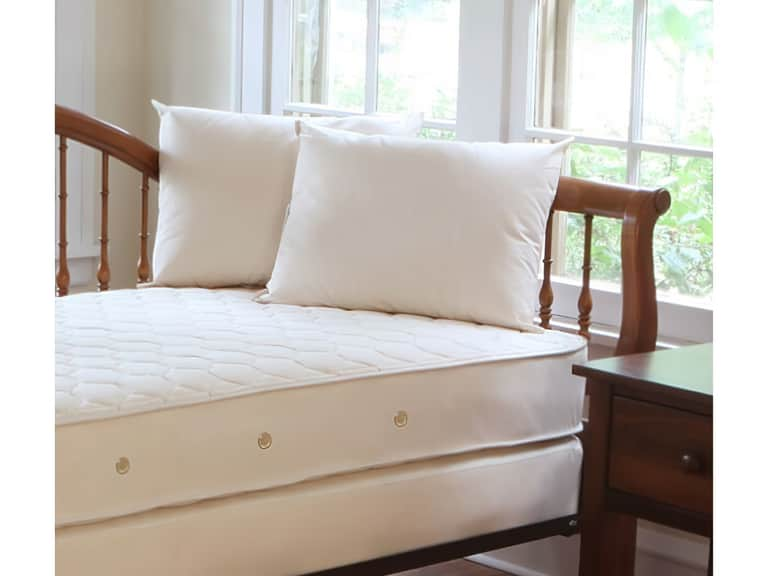
The specific Naturepedic 2-in-1 Organic Cotton Kids Mattress described in the available product information is designed for a young child moving from a crib into a first “big” bed. The manufacturer’s description specifies a medium-firm feel and an innerspring core, with a smooth waterproof coating on the top and sides and a quilted organic-cotton surface on the other side. It is seven inches thick. Those details help explain its construction, but do not establish that either face is suitable for infant sleep in a crib.
Caregivers considering an infant mattress should check the exact model name, the label, the manual and the manufacturer’s current specifications. Confirm that the mattress is intended for the particular crib and the child’s age. If a retailer’s short description, an old listing and the product manual appear to conflict, rely on current manufacturer documentation and applicable safety guidance rather than guessing from a marketing phrase.
Why firmness matters for infant sleep
For an infant, the sleep surface should be firm, flat and level, with a fitted sheet designed for that mattress. “Firm” is not a judgment about adult comfort; it describes a surface that does not significantly indent or conform under the baby. A plush, padded or inclined surface can create hazards. The infant-facing side of a dual-sided crib mattress must therefore be the side explicitly designed and approved for infant use, if the manufacturer identifies one.
Firmness is also different from a mattress’s general quality or a grown-up’s preferred feel. Adults often choose a sleeping surface by considering pressure relief, cushioning or a sense of softness. Infant safe-sleep guidance takes a different approach: use a separate, firm sleep surface made for the child’s sleep space, and keep that space clear. A quilted appearance, natural fiber or “organic” label does not, by itself, establish that a surface is appropriate for a baby.
Place the infant on their back for every sleep, and keep pillows, loose blankets, toys, positioners and other soft objects out of the sleep area. Use a fitted sheet that fits the mattress properly; do not add a topper or extra padding to change the feel. Follow current guidance from public-health authorities, including the American Academy of Pediatrics, and consult the product’s instructions. Safe sleep is a system of practices, not a quality that can be supplied by one material or one mattress feature.
When a child outgrows a crib and transitions to a larger bed, the appropriate sleep setup changes. That transition is a separate stage from infant sleep, and a mattress’s softer face may be intended for an older child rather than a baby. Do not turn a toddler or kids mattress over for infant use unless the exact model’s instructions explicitly say it is designed and approved for that purpose.
Comparing the two surfaces
On the Naturepedic kids mattress described here, the waterproof face is smooth, while the opposite face has organic-cotton quilting and is non-waterproof. The manufacturer describes the overall support as orthopedic medium-firm. These terms describe the product’s construction and intended use; they are not a substitute for assessing the child’s age, bed frame, or the specific instructions supplied with the mattress.
A smooth surface can be easier to wipe after an accident. The quilted face may feel more cushioned to a child and can be used when a waterproof surface is no longer needed, according to the product description. Yet the two faces are not simply “safe” and “unsafe,” nor are they a universal infant-versus-toddler rule. The manufacturer’s age guidance and the mattress’s intended setting are decisive. If you are evaluating an infant crib mattress, look for the specific infant-use information rather than inferring it from the two-sided format.
It is also useful to separate firmness from waterproofing. A waterproof layer describes resistance to liquid, not how firm a mattress is or whether it is appropriate for a given age. Likewise, a non-waterproof quilted surface is not automatically softer in a way that makes it suitable for an infant. Ask what the surface is made of, how it should be cleaned, which side belongs face up for the relevant stage, and whether the instructions require a particular foundation or bed frame.
What waterproofing means in practice
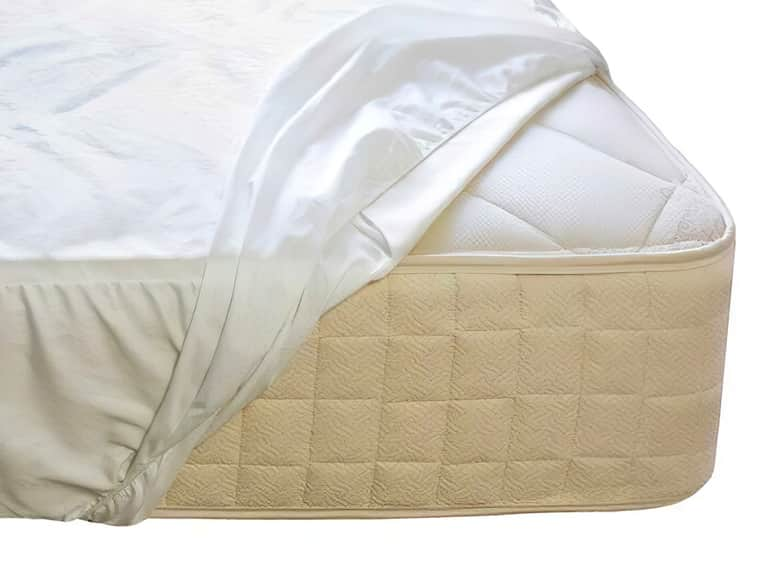
In everyday life, waterproofing helps limit the movement of liquid into a mattress. That can make cleaning easier and protect the interior from spills, urine or other moisture. Depending on the design, a barrier may be built into the mattress cover or supplied as a separate protector. The practical trade-off is that surfaces can differ in texture, breathability and care requirements. A waterproof label does not reveal every detail: check the stated materials, construction, cleaning method and warranty conditions.
The Naturepedic 2-in-1 kids mattress listing describes a non-toxic polyethylene waterproof coating on the top and sides of its smooth face. That is a specification for this particular product, not a universal description of all Naturepedic mattresses or all waterproof bedding. Caregivers should read current documentation for the exact model, including what the coating covers and which side should be used in each intended configuration.
A separate mattress protector is another possible approach, but it must be compatible with the mattress and the child’s sleep setup. For example, the Naturepedic Organic Waterproof Mattress Protector is described as an elasticized protector with organic-cotton jersey layers and a waterproof membrane. Its listed fit is for mattresses 9 to 16 inches deep. That makes it important to verify the depth and intended use before considering it: the 2-in-1 kids mattress described above is listed as seven inches thick, so the protector’s stated depth range does not match that mattress as described. Do not assume that a protector fits merely because the brand names match.
For an infant, extra layers must not interfere with a snug fit or change the safety characteristics of the sleep surface. Use only bedding permitted by the mattress and crib instructions. A waterproof protector should not be substituted for a fitted sheet unless the product’s directions and relevant safe-sleep recommendations explicitly allow that arrangement. Never improvise with loose plastic, thick pads or makeshift covers.
Fit: the quiet detail with high stakes
A mattress must fit its crib securely. Gaps at the edges can create a risk of entrapment, while a mattress that is too large, too small or not designed for the frame may sit improperly. Check the crib manufacturer’s requirements and mattress dimensions, then follow the relevant safety instructions. A mattress should lie flat and remain stable in the frame; the fitted sheet should be made for its size and should not come loose.
Do not rely on a quick visual impression alone. Measure the sleep space and compare it with the mattress dimensions and the crib’s manual. Confirm that corners sit correctly and that the mattress does not shift or bow. If the frame is adjustable, use only the settings allowed by its manufacturer and make sure the mattress remains properly supported at each position. Do not combine unrelated parts or use a mattress that has been altered, damaged or fitted with an unapproved layer.
The kids mattress listing gives a thickness of seven inches and notes compatibility with trundle beds, platform beds, bunk beds and traditional foundations. That information concerns the children’s mattress and its stated settings. It should not be read as a crib-fit specification or as permission to place the product in any crib. For every sleep surface, match the mattress to the exact bed type and follow both the frame and mattress instructions.
Care, cleaning and the question of durability
Waterproofing may reduce the amount of moisture that reaches a mattress’s interior, but it does not make a sleep surface maintenance-free. Follow the manufacturer’s cleaning directions, and avoid chemicals, abrasives or heat that could damage a coating or fabric. If a surface is designed to be wiped clean, use only the method specified in the manual. Do not soak the mattress or remove a cover that is not intended to be removed.
For a two-sided design, check whether turning or flipping is recommended, and whether the manufacturer gives a schedule. Some mattresses are made to be rotated but not flipped; others have distinct intended sides. The construction may also affect how the mattress should rest on its base. Keep instructions and warranty information accessible, especially if the mattress is passed between caregivers or used through more than one stage.
Regularly examine the cover, seams, edges and support beneath the mattress. If the mattress is torn, deeply stained, sagging or otherwise damaged, seek guidance from the manufacturer about whether it remains suitable for use. A cracked or peeling waterproof layer may no longer provide the protection described, while a loose cover or damaged seam can create a different concern. Avoid assuming that an organic-material claim guarantees durability or safe condition indefinitely.
Organic materials and the limits of labels
Families often consider organic bedding because they want to understand how fibers were grown or processed and what materials are present in a sleep environment. Certifications can help answer specific questions, but their scope varies. A certification applying to cotton fabric, for example, does not necessarily certify every component of a complete mattress. Read the claim closely: identify the certified material, the standard, the product or facility covered, and whether the certificate is current.
Terms such as “natural,” “non-toxic” and “eco-friendly” can appear in product descriptions, but each needs context. Ask for a bill of materials or detailed component information when available. Consider the full construction—cover, filling, waterproof layer, spring unit, adhesives and any other components—rather than judging a mattress by one fiber or a single badge. Organic status also does not replace safety testing, a snug fit or age-appropriate use.
Caregivers can keep the evaluation practical. Start with the sleep-safety requirements for the child’s age. Then compare the exact model’s materials, construction, dimensions, waterproofing and cleaning directions. Finally, consider whether the bed frame and sheet match the mattress. This order helps keep environmental preferences in view without letting them obscure the basic requirements of a safe sleep setup.
A careful checklist for caregivers
- Confirm the exact model. Similar names may refer to a crib mattress, a toddler mattress or a children’s mattress with different instructions.
- Verify the intended age and setting. Do not assume a kids mattress is approved for infant use or that a softer face is appropriate for a baby.
- Use the correct surface. For infant sleep, use only the firm, flat surface explicitly intended for that purpose and follow current safe-sleep guidance.
- Check the fit. Compare mattress dimensions with the crib or bed instructions, and use a snug fitted sheet made for that mattress.
- Understand the waterproof layer. Check which surfaces are protected, what materials are specified, and how the manufacturer says to clean them.
- Assess protectors by dimensions. Compare the protector’s stated depth range with the actual mattress and confirm compatibility with the intended sleep arrangement.
- Keep the sleep space clear. For infant sleep, avoid pillows, loose bedding, toys, toppers and other unapproved soft objects.
- Revisit instructions over time. Follow the manufacturer’s guidance when changing stages, flipping a mattress or moving it to a different frame.
The larger lesson: design follows the child’s stage
A two-sided mattress can be useful when its surfaces are designed for clearly defined stages and used as directed. The central comparison is not simply hard versus soft, or organic versus conventional. It is whether a particular side is intended for a particular child, in a particular bed, at a particular stage—and whether the bedding around it preserves the required fit and flatness.
For the Naturepedic 2-in-1 Organic Cotton Kids Mattress described here, the waterproof smooth face and the quilted non-waterproof face offer different practical features for a child moving beyond the crib. The mattress’s own description frames it as a kids mattress, with medium-firm support and a waterproof top-and-side surface on one face. Those details should not be generalized into infant guidance. If your question concerns a baby in a crib, consult the exact crib-mattress model’s current safety documentation and public-health recommendations.
In a child’s room, the smallest details—the edge of a fitted sheet, the depth of a mattress, the condition of a seam—can matter as much as the larger claims printed on a label. A careful comparison begins with age and fit, moves through firmness and waterproofing, and ends with materials and maintenance. That sequence keeps the conversation grounded: comfort and environmental priorities are important, but they belong within a sleep setup that is first and foremost appropriate for the child.
Safety note: This article is informational and is not a substitute for current safe-sleep guidance, medical advice or the instructions for a specific mattress and crib. Product specifications can change. Confirm details with the manufacturer and follow applicable public-health recommendations.